Acoustic panels for recording: placement and a home recording corner
Acoustic panels cut the echo inside a room; they do not keep out the neighbours. For recording speech, a few panels in the right places do more than a whole wall of them.
Updated · 7 min read
Short answer
Acoustic panels reduce echo inside a room. They do not stop noise passing through walls: that is sound isolation, which needs mass and airtight construction. For speech in a home studio, acoustic panel placement depends on where your voice bounces back into the microphone. Put absorbing panels on the wall behind you, which the microphone faces, at the side-wall reflection points and on the ceiling above, with thicker panels in the corners. Check the result with a test recording.
Treatment or isolation
Treatment controls echo inside the room; isolation stops sound getting in or out
First panel
The wall behind the speaker, which is the one the microphone faces
Thickness
Thin foam absorbs mainly high frequencies; thicker panels reach lower
Slat panels
They absorb some sound, mostly in the mid and high frequencies
No renovation
A full wardrobe, a duvet and a rug can treat a recording corner
Soundproofing or acoustic treatment: which does a recording need?
Soundproofing, or sound isolation, stops sound passing between the room and the outside. Acoustic treatment changes how sound behaves inside the room. Panels on the wall are treatment: your voice sounds closer and drier, but you can still hear the lift in the stairwell.
Sound isolation and acoustic treatment
Feature
Sound isolation
Acoustic treatment
Goal
Keep sound in or out
Control echo inside the room
How
Mass, decoupled layers and sealed gaps: door seals, double walls, better windows
Absorbers, diffusers, bass traps and soft furnishings
Done by
Builders, usually during a renovation
You, with panels and furniture
Fixes in a recording
Traffic, neighbours, a lift
A boxy, hollow, echoing voice
In home recordings the usual problem is echo: it makes the voice sound hollow, and treatment fixes it. If you can hear traffic or the neighbours, the noise is coming in from outside, and only isolation work or a different room will help. The guide to improving audio quality shows how to tell echo from noise and what you can still fix after recording.
Where should you put acoustic panels in a home studio?
Work in this order, and record a test after each step:
Choose the recording spot before you buy anything. Sit away from walls and corners, a little off the exact centre of the room, and away from two bare walls that face each other.
Put the first one or two panels on the wall behind you, the one the microphone faces, centred at mouth height.
Find the side reflection points. Sit where you will record and ask a friend to slide a mirror flat along the side wall at mouth height. Wherever you can see the microphone in the mirror, mark the wall: a panel goes there. Repeat on the other side.
Hang one panel on the ceiling above the microphone. This is often called a cloud.
Fill the corners with thicker panels or bass traps, floor to ceiling if you can.
Cover a hard floor with a rug.
Why start behind you? A cardioid microphone, the usual type for speech, picks up mostly from the front and rejects sound arriving from behind it. It faces you, so after your voice, the wall behind your head is what it hears most.
How many acoustic panels does a small room need?
There is no fixed number. Start with the spots above: behind you, one on each side and one overhead. Record, listen, and add panels only where the voice still rings.
Thickness matters more than the count. Thin foam tames only the highest frequencies, so a room lined with it can sound dull and still boom. Panels of around 5 cm or more, mounted with an air gap behind them, absorb further down into the range of the voice.
Whether you buy panels in Riga or order them online, compare their thickness, size, core material and fire rating. These decide the price, and the number of panels in a pack tells you little about the result.
Do decorative slat panels help the sound?
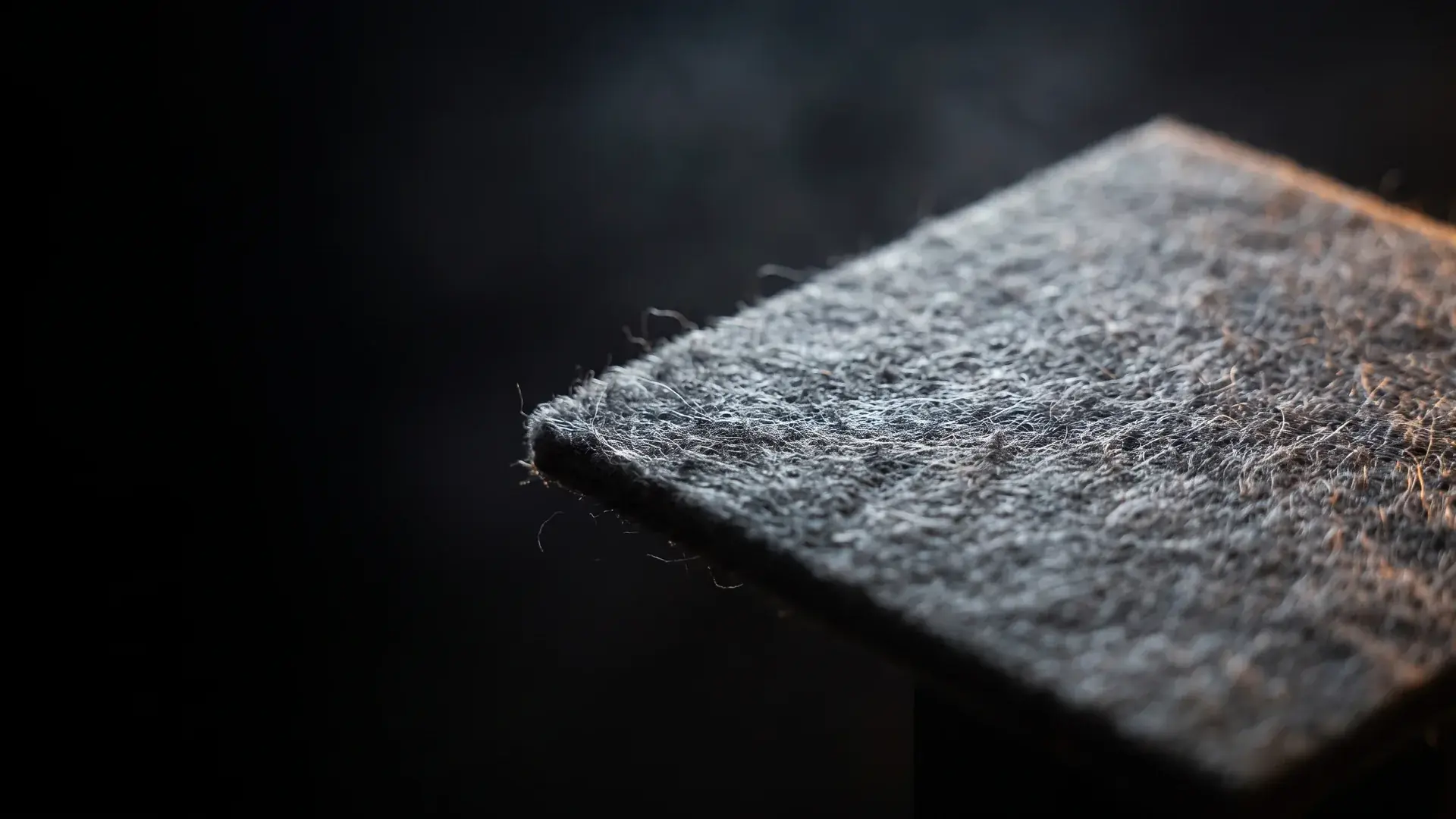
Slat panels are wooden slats fixed to a felt backing, usually sold as wall decor. They absorb some of the mid and high frequencies and scatter a little sound between the slats. Mounted over mineral wool or with an air gap behind them, they absorb more.
To compare products, look in the maker's data for the sound absorption class under EN ISO 11654, from A (the highest) to E, or for the weighted sound absorption coefficient, αw, on which the class is based.
Slat panels make a living room sound calmer. For recording, they work best alongside thicker panels at the reflection points.
How do you build a recording corner without renovating?
Heavy, soft things you already own absorb echo well enough for speech:
an open wardrobe full of clothes, with you facing into it as you record;
duvets or heavy blankets hung behind and beside you;
a sofa, cushions and a rug;
full bookshelves, which scatter sound;
heavy curtains over the window.
A reflection filter, the curved shield that clips behind a microphone, mostly blocks sound arriving at the back of the mic. The wall behind you still matters, because the microphone faces it.
If you are deciding between a corner at home and a booked studio for voice work, the guide to recording a voice-over compares the two. The microphone matters too: a dynamic microphone close to the mouth picks up more of your voice and less of the room.
How do you test the room before and after?
Record 30 seconds of speech at the recording spot, then 10 seconds of silence (room tone). Note the microphone, the distance and the input level.
Put up the panels.
Record again with exactly the same microphone, distance and level.
Compare the two recordings on headphones. Listen for a hollow, boxy sound and for a tail of echo after each word.
If you also want numbers, measure the room with Room EQ Wizard (REW). Its site describes REW as a set of free tools for measuring rooms, speakers and audio devices. You need a measurement microphone, and the site names a calibrated USB microphone as the simplest setup.
When is renting a studio cheaper than treating a room?
Before you buy panels, answer four questions:
How often do you record? Treatment pays off in a room you use every week, less so for a few recordings a year.
Do you already own good microphones?
Is the problem echo, which treatment fixes, or noise from outside, which panels cannot fix?
Is the room rented, so that you cannot fix anything to the walls?
If the answers point away from treating your own room, you can rent the set at our studio in Riga with professional lighting for €35/h, adding microphones and cameras at extra cost. Or book voice recording on professional microphones for €60/h, with mastering included.
No. Foam absorbs echo inside the room. Keeping the neighbours' noise out takes mass and sealed gaps, which is building work.
Can I make acoustic panels myself?
Yes: build a wooden frame, fill it with a few centimetres of mineral wool or another porous absorber, and stretch breathable fabric over it. Wear gloves and a mask when you cut mineral wool, and check the fire rating of every material.
Do panels on the ceiling help?
Yes, above the recording spot, and most of all in rooms with a low, hard ceiling.
Do egg cartons work?
No. They are too thin and too light to absorb speech frequencies in any useful way.
Do I need treatment if I use a dynamic microphone?
Less of it. A dynamic microphone close to the mouth hears more voice and less room, but a very echoey room still comes through.