A business headshot sits on your CV, your LinkedIn profile and the company website for years. A good one comes mostly from preparation, soft light and a calm background.
Updated · 8 min read
Short answer
A good LinkedIn headshot shows you as you look on a good working day: a calm background, soft, even light from the front, sharp eyes and clothes that suit your field. Plan the outfit and the background, sleep well the night before, and take plenty of frames so you have a choice. AI headshots are quick and cheap but often change your face, so for a CV or LinkedIn a real portrait is the safer choice.
Framing
Head and shoulders, eyes about a third from the top, a little space above the head
Light
Large and soft, from the front and slightly above; continuous light shows the result as you shoot
Background
Plain or softly blurred, in a tone that contrasts with your hair and clothes
Clothes
Solid colours; no fine stripes, small checks or big logos
Photo studio rental
€35/h: continuous light, a grey curtain with optional RGB backlight
What makes a good business headshot?
Start with where the photo will go, because that decides the style. A CV photo should be neutral and simple (in Latvia, CVs on job portals often include one). On LinkedIn you can look more approachable and show a little personality. A company website needs the whole team shot the same way, and a speaker or press bio calls for a few variants, vertical and horizontal.
Whatever the use, four things have to be right: sharp eyes, natural skin tone, a recent likeness and a background that does not pull attention away from your face. The common mistakes are a holiday photo cropped down to a face, a wide-angle selfie that stretches the nose, harsh light from overhead, a busy office behind you and heavy retouching.
Headshot style by where it will be used
Use
Crop
Expression
Background
CV and job portals
Head and shoulders, square or vertical
Neutral, with a light smile
Plain, light or mid grey
LinkedIn
Head and shoulders, centred for the round crop
Open and relaxed
Plain, or a brand colour, softly lit
Team page
The same crop for everyone
Friendly and consistent across the team
One background for the whole team
Speaker or press bio
Head and shoulders plus a looser frame, vertical and horizontal
Confident, in a few variants
Plain, with room to crop for different layouts
Many teams in Riga work in Latvian, Russian and English, and their websites often run in all three. A matching set of portraits keeps the team page consistent in every language. If the headshot is part of a wider personal brand, video can be the next step: see personal brand video.
How should you prepare for a business photoshoot?
Decide where the photo will be used: a CV, LinkedIn, the company website or all of them.
Collect three to five portraits you like and show them to whoever takes the photo.
Plan two or three outfits.
Get your hair cut about a week before the shoot; a cut done the day before rarely looks natural yet.
Sleep well and drink enough water the day before.
Arrive early and give yourself a few minutes to settle in before the first frame.
Matte skin photographs better than shiny skin, and men benefit from a little blotting powder too. If the photos will be in use for years, a professional make-up artist is worth considering.
Pack a lint roller, a comb, a spare shirt and a cloth for your glasses, or decide in advance to shoot without them.
What should you wear for a headshot?
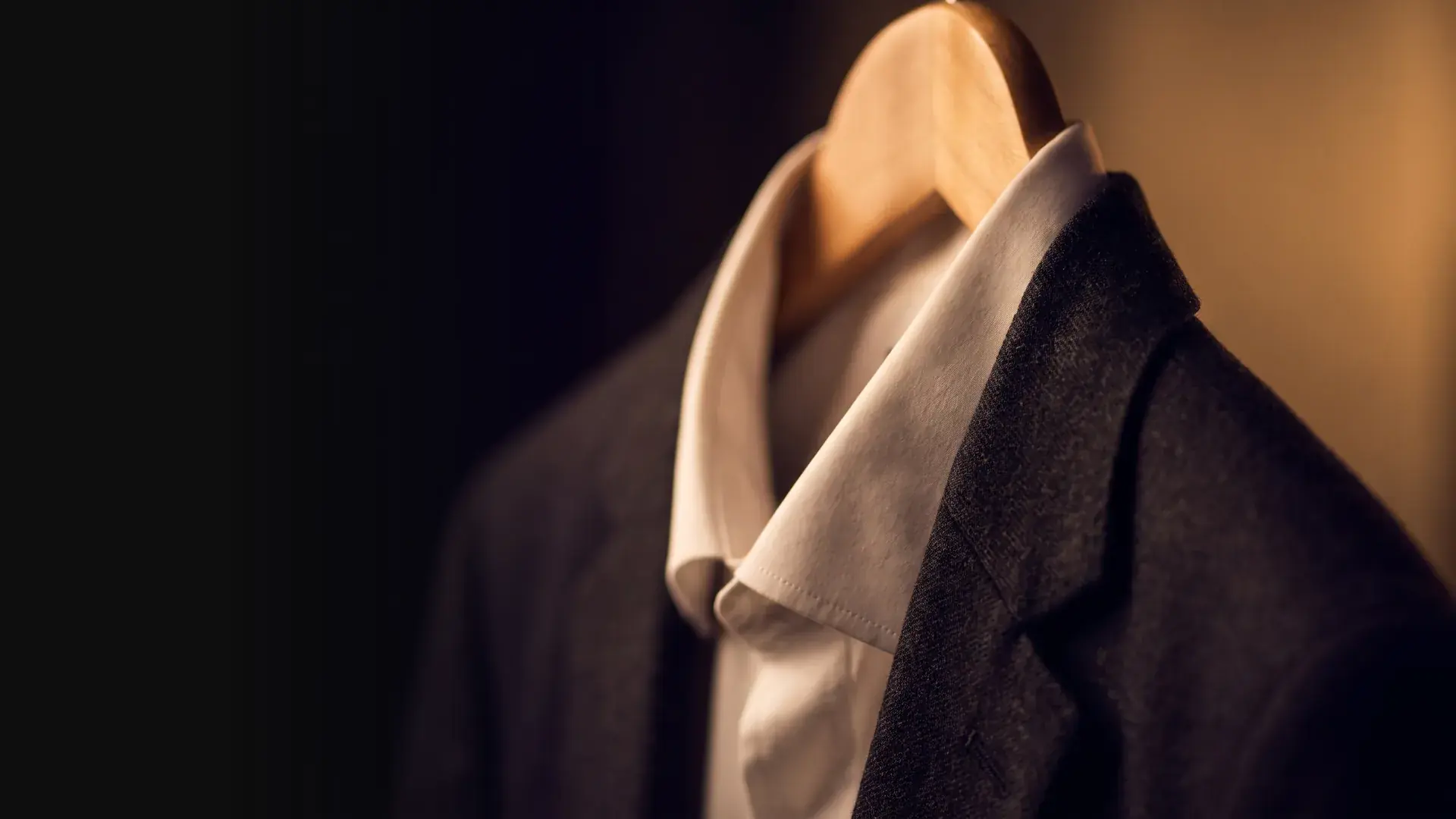
Solid mid-tone colours suit most skin tones: navy, grey, a muted blue or green, burgundy. Bright white and pure black tend to lose the detail in the fabric. The neckline frames your face: a collar or a jacket adds structure, while a crew neck reads as casual.
Leave these at home:
fine stripes and small checks, which shimmer on camera (the moiré effect);
large logos;
shiny fabrics and very busy prints;
new clothes or shoes you have never worn, because you will look stiff in them.
Dress one step above what you wear to work on an ordinary day, so the photo still looks like you. In finance and law, that usually means a jacket. In creative fields and IT, smart casual works. In medicine and the trades, your work clothes can be the point of the picture.
How do you pose, and which background works best?
Turn your shoulders slightly away from the camera and your face back towards it. Bring the chin a little forward and down, and let the shoulders drop. A real half-smile comes more easily after a slow breath out, or a short joke from the person behind the camera, than on command. The camera should be at eye level or slightly above.
Neutral grey suits almost any outfit, which makes it the safest LinkedIn headshot background. A coloured background, such as a backlight in your brand colour, adds personality on LinkedIn and on a website. For a team, choose one background and keep it for everyone. To get a sense of a grey backdrop under coloured light, look through the studio photos.
The usual lighting setup is a large, soft main light in front, a reflector or a second light to fill the shadows, and a rim or background light that separates your head from the backdrop.
Take many frames and vary the expression a little between them. Then choose with someone honest, comparing two frames at a time. If there is time left, studio photoshoot ideas can give you more looks from the same set.
AI headshots or a real portrait: which is better?
An AI headshot generator takes a set of your selfies and returns portraits of you in suits and offices you have never been to. Some people ask a general assistant such as ChatGPT or Gemini to do the same with a single selfie. Either way, it is fast, cheap or free, and you get many variants.
The weak point is likeness. Teeth, eyes, the jawline and the hairline drift, hands and clothing come out wrong, and the overall look is generic in a way recruiters increasingly recognise. The person who walks into the interview should match the photo.
A sensible rule: an AI headshot can serve as a placeholder, while a CV, LinkedIn or a team page deserves a real photo. Upload only your own photos, never other people's, and read the tool's terms on how it uses your images.
Four ways to get a business headshot
Option
Cost and time
Likeness
Best for
AI headshot
Lowest; minutes
Often drifts
A temporary placeholder
Phone portrait at home
Low; an hour with a friend
True, if the light is good
A CV or a first LinkedIn photo
Rented studio with your own photographer
Medium: studio hours plus the photographer's fee
True, with controlled light
LinkedIn, a team page, a speaker bio
Full photographer service
Highest
True, with professional direction
Company portrait sets, press
How can you take a good headshot on a small budget?
With a friend and a phone, stand facing a window for soft daylight, with a plain wall a metre or two behind you. Hold the phone at eye level and use the 2x lens rather than the wide one, which distorts faces up close. Turn portrait mode off if it smears the edges of your hair.
On your own, put the phone or camera on a tripod, use the timer or a remote, and take many frames.
In a rented studio, the light and the background are already in place, so a colleague or your own photographer only has to frame the shot and press the button. At Baltic Podcast Studio in Riga, the photo studio costs €35/h. It has continuous light, so you see the result as you shoot, and a grey curtain with an optional RGB backlight in any colour. A partner stylist can also do your hair and make-up before the shoot if you book it at least 3 days ahead. You can rent the photo studio and bring your photographer, or take turns photographing each other. Photographers set their own fees, so ask for a quote that covers both the shoot and the retouching.
Afterwards, keep the retouching light. Remove blemishes and stray hairs, and leave the wrinkles and your features as they are.
Frequently asked questions
How often should I update my headshot?
When your look changes noticeably, or every couple of years.
Should I smile in a business photo?
Usually yes, with a natural, relaxed smile. Take some serious frames as well, and choose by where the photo will be used.
What size should a CV photo be?
Check what the job portal or the employer asks for. A square head-and-shoulders crop is a safe default.
Can glasses ruin a headshot?
Reflections can. Tilt the frames down slightly or move the light to the side, and keep the glasses on if people know you in them.
Can a whole team be photographed in one session?
Yes. Fix the background, the light and the crop first, then bring people in one after another.